
Nonfunctional Turf Irrigation Ban
California AB 1572 prohibits the use of potable (drinking) water to irrigate nonfunctional turf (grass) on commercial, industrial, institutional, and HOA common areas. The law phases in from 2027 through 2031 and requires self-certification of compliance for certain properties.
What the law does
AB 1572 targets nonfunctional grass that is not regularly used for recreation, events, pets, civic purposes, or community gathering. It does not apply to residential properties or functional turf.
- Applies to CII (Commercial, Industrial, Institutional properties and HOA common areas)
- Does not apply to single-family homes
- Does not apply to functional recreational turf
AB 1572 applies to these property types
The law applies to nonfunctional turf located on the following property categories.
Commercial
Business parks, shopping centers, office complexes, churches, and similar non-residential properties.
Industrial
Industrial sites and related properties with ornamental turf not used for recreation or civic purposes.
Institutional
Hospitals, universities, schools, public facilities, and other institutional properties.
HOA Common Areas
Shared areas not directly in front of or behind single-family homes.
Nonfunctional vs. functional turf
AB 1572 distinguishes between ornamental grass and grass used for recreation, gathering, or other active purposes.
What is nonfunctional turf?
Nonfunctional turf is ornamental grass that is not regularly used for human recreation or civic purposes.
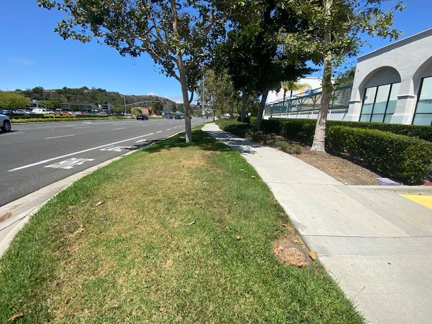
- Grass street medians or parkways
- Decorative grass around commercial buildings or office parks
- HOA common area grass not used for events or human or pet recreation
What turf is exempt?
Functional turf is grass that is actively used for recreation, gatherings, pets, or public benefit.
- Public parks
- Sports fields
- Playgrounds
- School, church, or community gathering areas
- Dog parks and dedicated pet relief areas
Do You Have NFT?
Nonfunctional turf (NFT) is grass that is watered but serves little or no practical purpose. These areas are typically decorative and aren't regularly used for recreation, gatherings, or other everyday activities. If the only person who regularly steps on the lawn is your landscaper, it may be considered nonfunctional turf.
Not sure if your property qualifies? Click the link below to learn more and check your property.
Check My Property for NFTNeed help determining which rebates and programs you qualify for? Contact Riverside Public Utilities' Programs and Services team at [email protected] or (951) 826-5485. We're here to answer your questions and help you find the right resources.
Key facts for Riverside property owners
This State of California law affects the City of Riverside and eligible properties located within the city.
AB 1572 does not apply to the lawn of a single-family home, including a single-family home located within an HOA.
Front and back yards directly associated with single-family homes are not considered HOA common areas under this guidance.
Examples include neighborhood entrances, parkways, medians, grass in parking lots, slopes, and areas near community buildings.
Phased implementation schedule
The law phases in over several years, depending on the property type and location.
January 1, 2027: State and local government properties
State and local government properties must stop watering nonfunctional turf with potable water. This first phase sets the standard for public entities.
January 1, 2028: Commercial, industrial, and institutional properties
The ban extends to business parks, shopping centers, office complexes, hospitals, universities, churches, and other non-residential properties.
January 1, 2029: HOA and shared community common areas
Common areas within homeowners associations and other shared communities must comply with the nonfunctional turf irrigation ban.
January 1, 2031 or later: Disadvantaged communities
For properties located in disadvantaged communities, the ban takes effect once dedicated funding becomes available to support the transition to water-efficient landscapes.
Turf Replacement FAQs
Common questions about potable water, CII properties, HOAs, condominiums, churches, and compliance.
What is potable water?
Potable water is another name for drinking water.
What is Functional Turf?
A ground cover surface of turf located in a recreational use area or community space. Turf enclosed by fencing or other barriers to preclude human access for recreation or assembly is not functional turf.
What is a Recreational Use Area?
An area designated by a property owner or a governmental agency to accommodate human foot traffic for recreation, such as sports fields, golf courses, playgrounds, picnic grounds, or pet exercise areas. This recreation may be either formal or informal.
What are CII properties?
CII stands for Commercial, Industrial, and Institutional properties.
Do all CII properties with nonfunctional turf have to comply?
Yes. All CII properties must comply with the law. However, only properties with more than 5,000 square feet of nonfunctional turf are required to submit the certification form.
Is there a difference between a front lawn for a single-family home in an HOA and a townhome front lawn in an HOA?
Buildings of four units or fewer are considered residential, and the turfgrass would not be subject to the bill.
Where do churches fall under the law?
Churches are considered commercial properties and must comply with the bill starting January 1, 2028.
Is the lawn in front of a condominium building considered functional turf because it is residential?
Condominium buildings are not considered single-family residential. As a CII property, they are subject to the bill. AB 1572 applies to common areas.
In an HOA, is turf around a separate single-family home treated differently than turf in front of connected condominium homes?
Yes. Turf around a separate single-family home may be exempt, while common-area turf in front of connected condominium homes may be subject to the law.
If an HOA maintains the front yard grass of a single-family home, is that grass exempt?
Yes. Front and back yards are not considered HOA common areas. Therefore, AB 1572 is not applicable to those areas.
In an HOA, what is considered common area?
HOA common areas are areas not directly in front of or behind single-family homes. Common examples include neighborhood entrance areas, parkways, medians, grass in parking lots, large grass areas on slopes, and grass near community buildings.